Syllabus
This course is an entry point into the game industry and related media arts. You will learn how games and media are made, who makes them, and the core skills needed to start. By the end, you will connect your interests to real careers and start a professional portfolio.
Canvas, this site, and Jupiter are your three main tools.
- Canvas → quizzes, homework/classwork submission, and class discussions.
- cte.levelarts.studio → project descriptions, lecture notes, readings, and resources.
- Jupiter → grades (synced as assignments are graded in Canvas).
There is no excuse for lost passwords — every student must maintain access to all three systems.
Course Information
Course Description
Intro to Media Careers introduces fundamentals of the Arts, Media, and Entertainment sector with a focus on game-related careers. Students explore industry roles, develop basic computer and design skills, and complete projects using Blender and Krita. Transferable skills—communication, collaboration, and organization—are emphasized. This course prepares students for Game Art & Design 1 and 2.
Learning Outcomes
Students will:
- Identify key roles in games and media arts.
- Demonstrate basic computer literacy for creative work.
- Apply visual storytelling and design basics.
- Create simple assets in Blender and Krita and present work.
- Draft a career plan and starter portfolio.
Starting Week 2, every week includes a journal project. These tasks ask you to think critically about media—sometimes by watching a film/show, playing a game, or reading a text.
If that’s not possible, alternatives are always allowed: create your own short story, write from past experiences, or propose a substitute. Speak with me if you’re unsure. The point is to practice critical media consumption and creation.
Weekly Points System
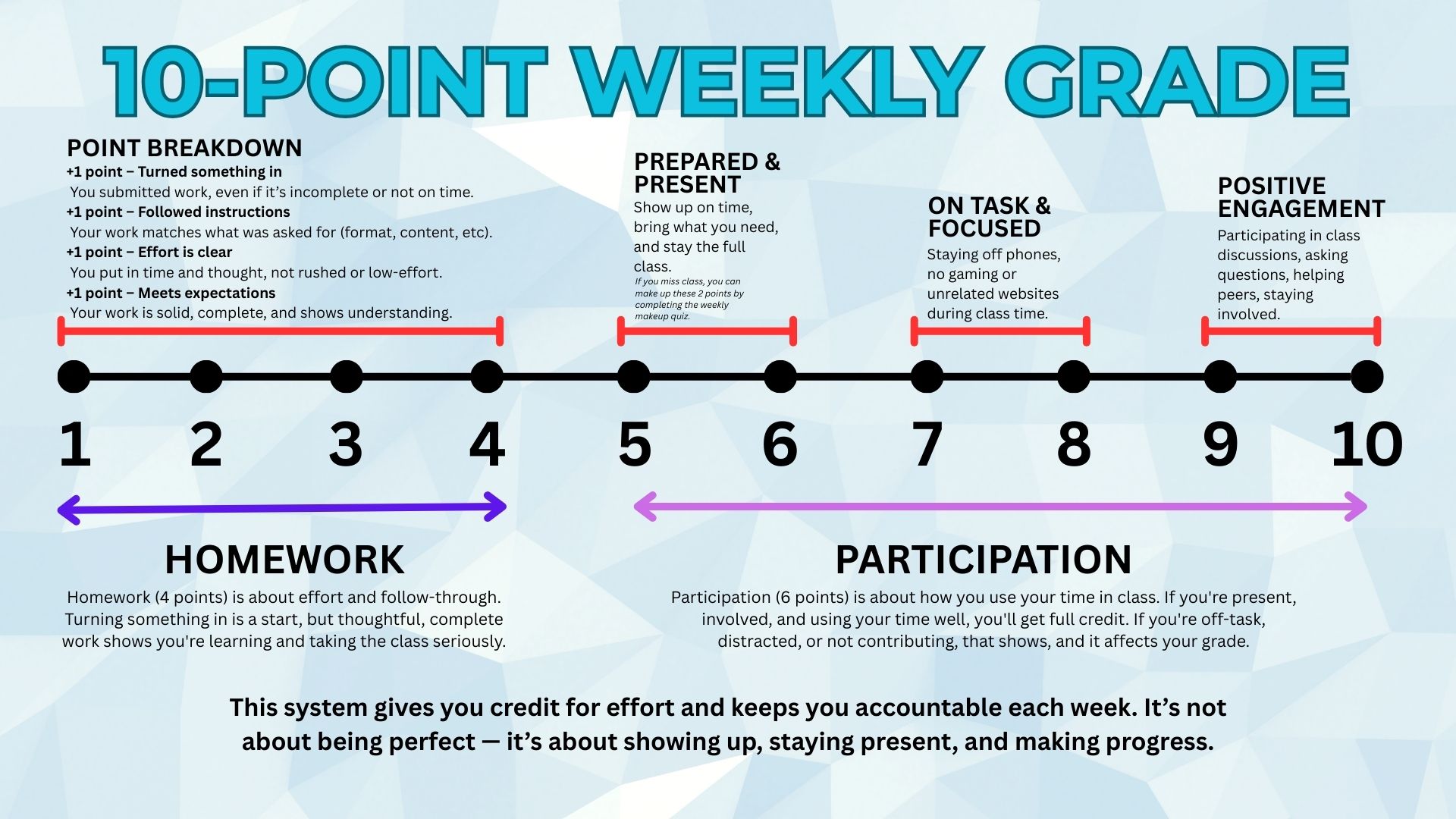
10-Point Grading System Breakdown
Every week you can earn 10 points. These are essential to your grade and track both participation and homework.
Participation
Participation is graded daily. Each class session you can earn credit in three areas:
Prepared & Present (2 pts)
- On time, ready with notebook, logins, and materials.
- Stay the full class period.
On Task & Focused (2 pts)
- Work on assigned projects.
- Limit distractions (no phones, unrelated sites, side conversations).
Positive Engagement (2 pts)
- Contribute ideas, answer questions, help peers.
- Respectful communication and collaboration.
Total = 6 points each week
Homework/Classwork
Homework includes Canvas submissions, small creative tasks, and journal assignments. Credit is earned as follows:
- Turned Something In (1 pt) — submit ALL required work by deadline.
- Followed Instructions (1 pt) — meets basic directions.
- Effort is Clear (1 pt) — shows genuine attempt, not rushed.
- Meets Expectations (1 pt) — demonstrates understanding and readiness for next step.
Total = 4 points each week
Example: Student A
Participation (0–2/6 pts weekly)
Student A rarely attends. When they do, they are distracted on their phone or gaming.
→ Consistently earns 0–2 points out of 6.Homework/Classwork (4/4 pts weekly)
Always submits homework on time, follows directions, and work is well done.
→ Consistently earns 4 points out of 4.
Total Weekly Score = ~4–6 / 10 points
Result: Strong homework cannot fully replace the loss from missed participation. Student A ends up with 60% or lower overall, despite good assignments.
Example: Student B
Participation (6/6 pts weekly)
Student B attends every day, stays on task, and engages positively.
→ Consistently earns 6 points out of 6.Homework/Classwork (0–2/4 pts weekly)
Rarely turns in homework. When submitted, it’s rushed or incomplete.
→ Consistently earns 0–2 points out of 4.
Total Weekly Score = ~6–8 / 10 points
Result: Strong participation helps keep Student B afloat, but poor homework effort caps their grade around the 70–80% range.
Homework can be turned in late only until the end of the unit it was assigned.
After that, points will be lost — 3 points deducted from the 10-point weekly total.
Final Projects
- 100 points each semester
- Two projects per year: one at the end of Semester 1 (Unit 3) and one at the end of Semester 2 (Unit 6).
- Each project spans multiple weeks of focused and tangential-to-unit work.
- Projects conclude with a finished product and a short presentation.
- Graded using a detailed rubric aligned to AME standards.
- Projects are worth a significant portion of your grade (30%).
- Even perfect weekly scores (~70%) only add up to a C at best.
- Strong final projects are essential to passing with a higher grade.
Weighting
| Assignment Type | Points | Weight | Due Date |
|---|---|---|---|
| Weekly Points | ~150 | 70% | Weekly |
| Final Project | 100 | 30% | End of Semester |
Grading Scale: A = 90–100, B = 80–89, C = 70–79, D = 60–69, F < 59